
The Cosmic Thread: When the Red Sail of an Indian Princess Met the Golden Realm of Gaya
- 1. Beyond the Screen: Senba’s Journey and the Legend of Queen Heo in ‘Made In Korea’
- 2. The Red Sail and the Sacred Stones: Evidence of the Gaya Connection
- 3. Linguistic Twins: The Eerie Parallels Between Tamil and Korean
- 4. A Cultural Mirror: Shared Flavors and Traditions of India and Korea
- 5. Redefining ‘Made in Korea’: A Fusion of Culture and Destiny
- 6. More Than Just a Label: The Living Legacy of a Shared Heartbeat
- * Sources & References
1. Beyond the Screen: Senba’s Journey and the Legend of Queen Heo in ‘Made In Korea’
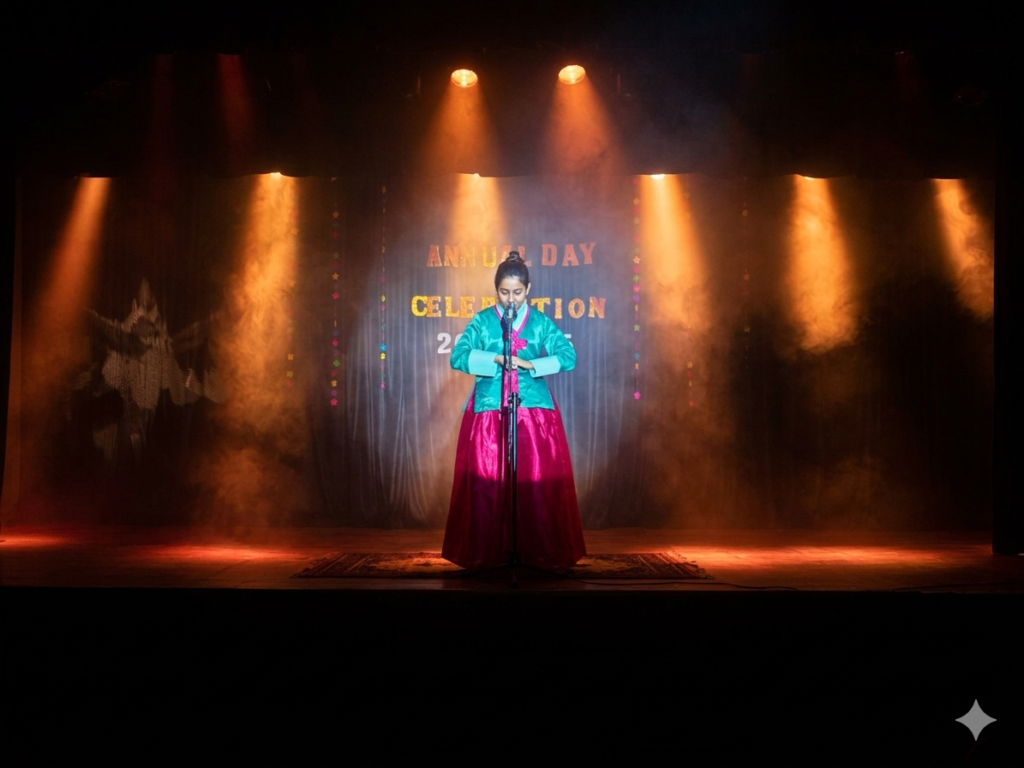
Imagine a young girl named Senba—or maybe her full name was Senbagam—standing in the center of a school stage, the spotlight catching the vibrant colors of her costume. She’s giving it her absolute all, playing the role of the ancient Queen Chembavalam. Seriously, she was so good that she actually walked away with the “Best Performance” award that day! But that wasn’t just a one-time thing; her friends actually started calling her “Chembavalam” as a permanent nickname because it sounded so much like her real name. This wasn’t just some school memory for her, though. It was the spark. That performance pushed her down a rabbit hole of curiosity that eventually turned into a full-blown obsession with Korea. She started dreaming of a land she had never visited, feeling a pull toward a place that somehow felt like it belonged to her. But here is the kicker that will absolutely blow your mind: what if I told you that this “Indian princess becomes a Korean queen” story isn’t just a neat piece of movie fiction? What if it’s a historical reality that is literally written into the DNA of over six million living Koreans today? It sounds like a total fantasy, right? Yet, for the descendants of the Gimhae Kim and Heo clans, this isn’t just a script—it’s their literal family tree. The image of Senba on that stage is a bridge, dragging a 2,000-year-old mystery out of the dusty archives and straight into our modern hearts.
2. The Red Sail and the Sacred Stones: Evidence of the Gaya Connection
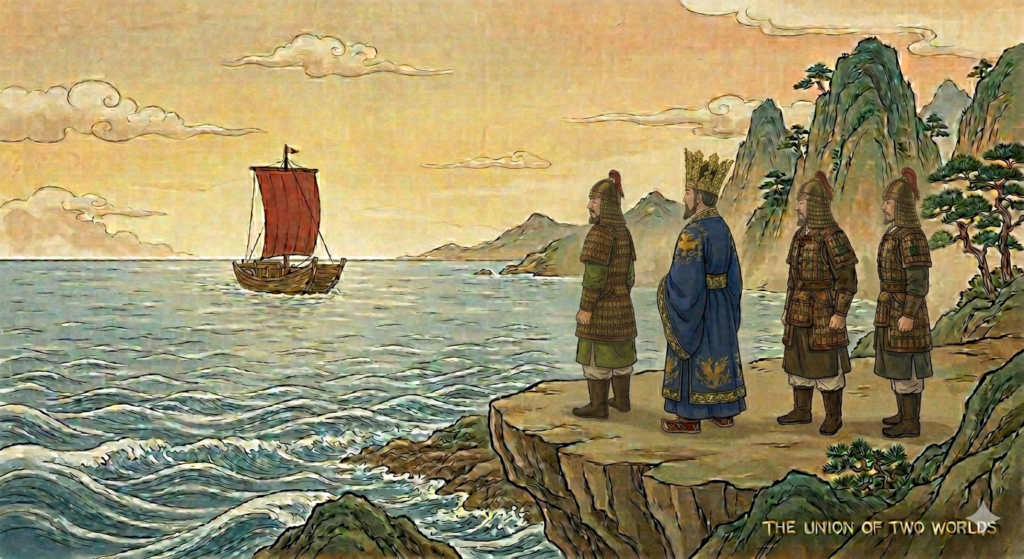
Let’s travel back—way back—to the year 48 AD. Picture a ship with a brilliant, blood-red sail cutting through the waves, heading toward the southern tip of the Korean peninsula. Onboard was Princess Suriratna, who we now know as Heo Hwang-ok. She was only sixteen, a royal from a place called “Ayuta.” Now, scholars have been arguing forever about where Ayuta actually was. Some say it was Ayodhya in the north, but some really thrilling recent research points toward the ancient Tamil kingdoms of South India, specifically the “Ay” kingdom near Kanyakumari. The story goes that her parents had a divine vision, a literal message from God, telling them to send their daughter to marry King Suro, the guy who founded the Gaya Kingdom. Can you even imagine the guts it took to say goodbye to everyone you knew and sail into the unknown just because of a dream? And the trip was rough! Legend says she actually had to turn back once because the sea gods were furious. To calm those raging waves, she placed “Pasa Pagoda” stones on the ship. These were sacred stones brought from her homeland to stabilize the vessel through both the spiritual and physical storms. When she finally hit the shores of Gaya, King Suro was already there waiting for her. He had been turning down every marriage proposal his advisors threw at him because he’d received his own divine heads-up.
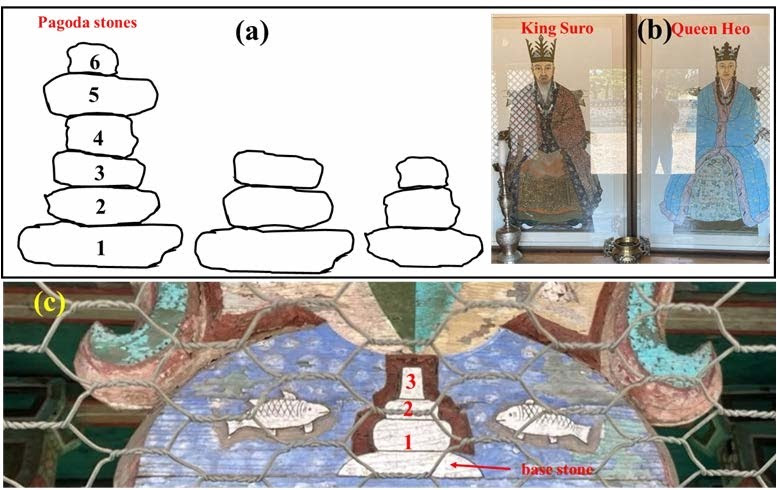
Those Pasa Pagoda stones aren’t just myths; you can actually go touch them today in Gimhae, right near the Royal Tomb of Queen Heo. What is truly wild is that these stones are geologically “foreign” to the entire Korean peninsula. They aren’t the kind of rocks you’d find anywhere in that region, which adds a massive layer of physical truth to the legend. They are stacked in a specific, tiered way, and for centuries, people have revered them for their power to protect travelers. When Suriratna stepped off that boat, she didn’t just rush to the palace. She insisted on proper ceremonies, showing a level of dignity that totally moved the King. She even took off her silk trousers and offered them to the mountain spirit—a gesture of piety that marked her start as the mother of a nation. This wasn’t just a wedding; it was a merger of two worlds. The couple had ten sons, and the King actually allowed two of them to take their mother’s surname, Heo. That was incredibly progressive for that time! Today, when you visit the quiet grounds of King Suro’s tomb, you are looking at the ground zero of a lineage that has lasted nearly two millennia.
3. Linguistic Twins: The Eerie Parallels Between Tamil and Korean
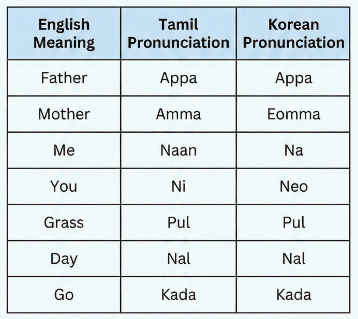
Now, let’s talk about that moment Senba starts learning Korean, because this is where things get really eerie. As she repeats the words, she gets this look on her face—half confusion, half “wait, I know this!” This isn’t just clever acting; it is based on the jaw-dropping parallels between the Tamil language and Korean. If you speak Korean, listen to this: what do you call your father? “Appa” (아빠), right? Well, in Tamil, it’s also “Appa” (அப்பா)! And mother? In Korean, it’s “Eomma” (엄마), and in Tamil, it’s “Amma” (அம்மா). It’s not just the basic family words either. “Na” (나) and “Naan” mean “me.” “Ni” (니) and “Nee” mean “you.” The word for grass is “Pul” (풀) in both. This is absolutely mind-blowing! When Senba felt that “familiarity” while studying, she was tapping into an ancient linguistic root that has left scholars scratching their heads for decades. There are over 500 words that share these uncanny similarities. Even verbs like “to learn”—”Baeuda” (배우다) in Korean—sound remarkably like the Tamil “Padi” (படி). It is as if a secret code was buried in the speech of two peoples separated by thousands of miles of ocean.
It goes even deeper than just single words; it’s about how the languages are actually built. Both Korean and Tamil follow a similar sentence structure that is totally different from English. And check this out: the script itself! While King Sejong the Great developed Hangul in the 15th century, some researchers have pointed out that the shapes might have been influenced by ancient scripts found in South Asia. In fact, some characters in the old Tamil Brahmi script look a lot like the geometric lines of Hangul. There is even a theory that King Sejong might have looked at these ancient Dravidian scripts as a reference when he was trying to create a system that was easy for common people to learn. Think about that for a second! The very letters used to write K-pop lyrics today might have a “long-lost cousin” in the stone inscriptions of ancient South Indian temples. It is no wonder Senba felt like she was coming home when she started speaking Korean; her native tongue and her new language were singing the same ancient song.
4. A Cultural Mirror: Shared Flavors and Traditions of India and Korea
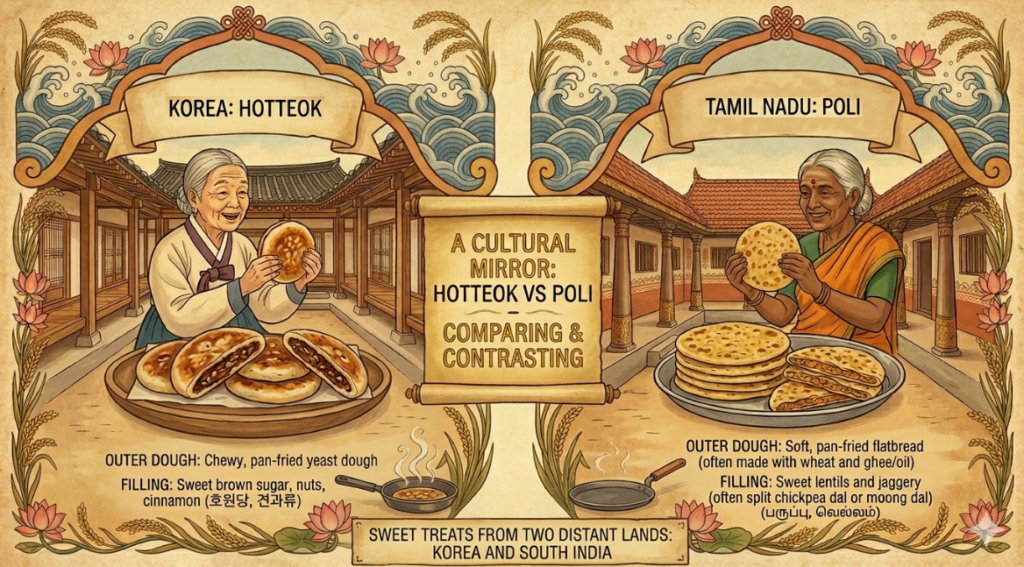
But the connection isn’t just about what comes out of our mouths; it’s about what we put in them! Let’s talk about food, the ultimate cultural glue. Have you ever tried the Korean snack “Hotteok” (호떡)? It is that delicious, sweet, pancake-like treat stuffed with brown sugar and nuts. Well, in Tamil Nadu, they have a snack called “Poli” (போளி) that is essentially its twin! Both are made from flour, pan-fried, and filled with sweet goodness like jaggery and coconut or lentils. And it doesn’t stop there. Look at the Korean “Jeung Pyeon” (증편)—those fluffy, fermented rice cakes. They are remarkably similar to the South Indian “Idli” (இட்லி), which is also a fermented rice cake that’s steamed to perfection. Both cultures are “rice cultures” through and through. They even share similar traditional housing styles. The Korean “Hanok” (한옥), with its beautiful open courtyards and wooden pillars, looks like a long-lost sibling to the “Thotti Kattu Veedu” mansions in Tamil Nadu. Even the way people show respect—the deep bow of the Korean “Sebae” (세배)—is echoed in the Tamil “Ashirvadam,” where children touch the feet of their elders to receive blessings. It’s like looking into a cultural mirror across time and space!
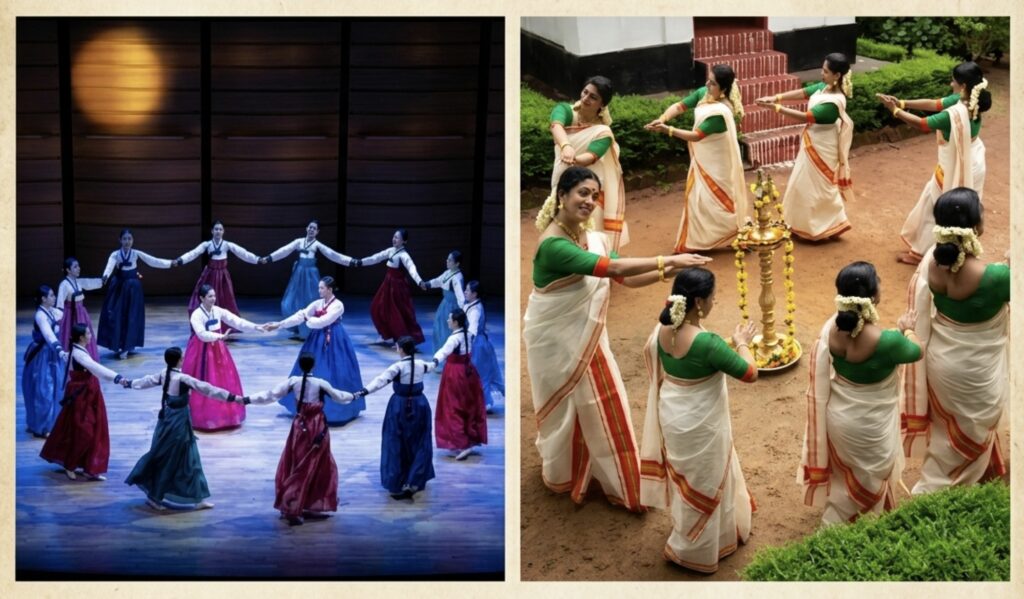
Wow, let’s look at the festivals too! Chuseok is the big harvest festival in Korea, lasting three days in early autumn. Over in Tamil Nadu, they celebrate Pongal for three to four days to mark their own harvest. Both involve massive communal meals and thanking the land for its bounty. Even the traditional dances are cousins. The Korean “Ganggangsullae” (강강술래) features women in traditional clothes dancing in a circle while singing. Tamil Nadu has “Kummi” (கும்மி), where women form a circle and dance to rhythmic hand claps. It’s the exact same vibe! And did you know that both India and Korea celebrate their Independence Day on August 15th? Seriously, they became independent exactly one year apart. And both regions were historically dominated by three great kingdoms—the Cheras, Cholas, and Pandyas in Tamil Nadu, and the Silla, Baekje, and Goguryeo in Korea. The historical parallels are just endless!
5. Redefining ‘Made in Korea’: A Fusion of Culture and Destiny
Let’s dive into the word “Pagoda” for a second, because the etymology is fascinating. Most people think it’s just a Chinese or Portuguese word. But some scholars suggest it actually comes from a fusion of the Tamil “Bhagavan” (meaning God) and “Kudai” (meaning umbrella). So, “Pagoda” literally means “Divine Umbrella.” This makes so much sense when you look at the tiered roofs of these structures—they look exactly like stacked umbrellas! And those “Pasa” stones? The word “Pasa” likely comes from the Sanskrit “pasasa,” which just means “rock” or “stone.” So the “Pasa Pagoda” is essentially the “Venerable Stone Umbrella.” It represents a spiritual ladder between the earthly realm and the divine. This tradition of stacking stones is alive and well in both places. If you walk along a beach in Jeju Island or near a temple in Tamil Nadu, you’ll see people stacking small stones into little towers, making a wish with every layer. It is a shared ritual of hope that has survived for thousands of years.

This brings us to the real heart of the matter: the title “Made in Korea.” In our modern world, we usually see that label on a smartphone or a car and think about factories. But after following Senba’s story and the legend of Queen Heo, that phrase takes on a much deeper, more soulful meaning. “Made in Korea” isn’t just about a place of origin; it is about the beautiful, messy, and glorious fusion of cultures and bloodlines. It’s about the fact that “Korean-ness” has been a blend of different influences from the very beginning. Senba’s journey is really a metaphor for all of us searching for our “other half,” for the roots we didn’t know we had. She wasn’t just “becoming” Korean; she was rediscovering an ancient part of herself that had been waiting 2,000 years to be woken up. She realized that her nickname, Chembavalam, was more than just a name—it was her destiny.
6. More Than Just a Label: The Living Legacy of a Shared Heartbeat
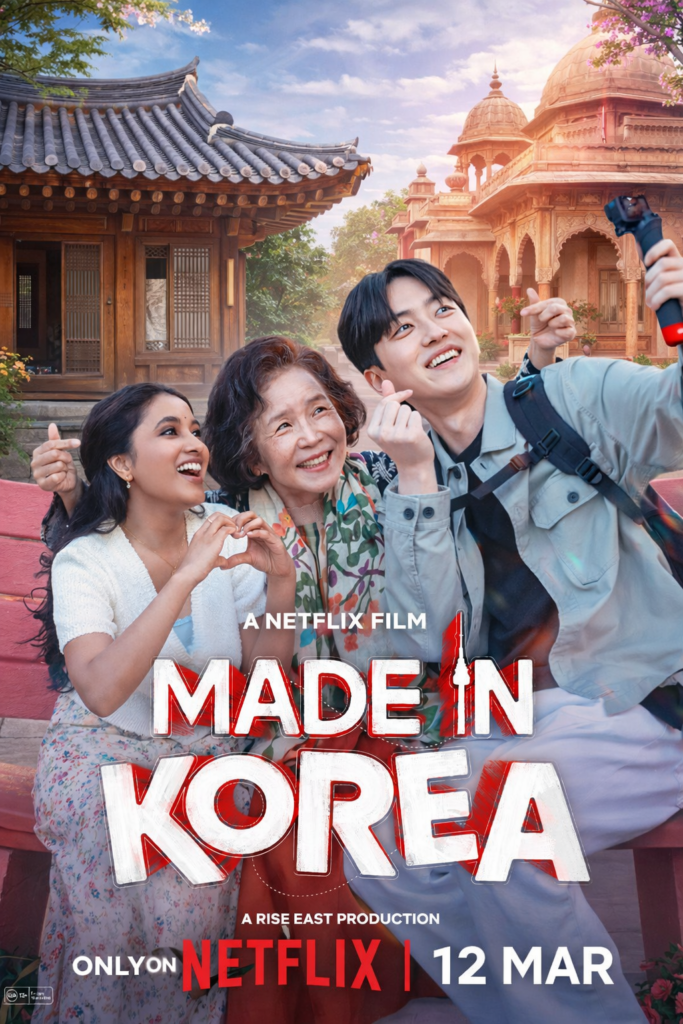
“Honestly, it is enough to give you chills! For me, the connection hits home in the smallest moments. When I see the actress Priyanka Mohan on screen, I feel a sense of kinship when she says ‘Kamsahamnida’ (Thank you), but it’s nothing compared to the shock of hearing her call her father ‘Appa.’ In that one word, the 3,000 miles between us just evaporate.
The next time you see a red sail or hear that word ‘Appa,’ I hope you think about Princess Suriratna and her brave voyage across the sea. Better yet, if you ever find yourself in South Korea, take a trip down to Gimhae. Walk through the gates of the Royal Tomb and stand before the Pasa Pagoda. Listen to the wind rustling through the trees and see if you can catch the faint, 2,000-year-old whisper of an Indian princess who traveled across the world for love and destiny.
Three characters pose for a cheerful selfie against a blended backdrop of Korean and Indian traditional architecture. This image is AI-generated and created for illustrative purposes.
It’s a place where history feels alive, where the distance between India and Korea disappears, and where you can feel the heartbeat of a shared heritage. Her story reminds us that we are all much more connected than we realize. We aren’t just isolated islands; we are part of a vast, interconnected sea of human history. Now that you’ve seen the evidence, doesn’t it make you want to look a little closer at your own story?”
Call to Action: This is just the tip of the iceberg, and I’m dying to know what you think! Which of these linguistic or cultural “twins” shocked you the most? Was it the “Appa/Amma” thing, or maybe the fact that Hotteok has an Indian twin called Poli? Between Korean and Tamil, which word do you think has the most incredible parallel? Drop a comment below and let’s get a discussion going! Who knows, maybe you’ve noticed a connection we haven’t even mentioned yet!

Sources & References
1. Scholarly Insights: Shanlax International Journal (2023, 2026)
– Lexical & Cultural Links: [V. RA. Alagu & G. Priyalakshmi] (2023) explores the deep linguistic roots and shared traits in food, clothing, and architecture between Tamil Nadu and Korea.
– The Pagoda Mystery: [I. S. Raja & A. R. Selvaraj] (2026) investigates the etymology of “Pagoda” (Divine Umbrella) and the Pasa stones, providing evidence of Queen Heo’s South Indian maritime origin from the ancient “Ay” Kingdom.
– Link: http://www.shanlaxjournals.com
2. Linguistic Research: Tamilmanam International Journal (2025)
– Script Comparison: [V. Bhuvana & Dr. G. A. Karthiga] presents a graphical analysis between ancient Tamil scripts (Brahmi/Vatteluttu) and Hangul, exploring the possibility of Tamil influence during King Sejong’s alphabet creation.
3. Official Historical Record: Academy of Korean Studies
– Royal Tomb of King Suro: Provides the definitive historical context of the Gimhae National Heritage site, including its 1580 reconstruction by Kim Heo-su and the physical layout of the royal precinct.
– Link: https://encykorea.aks.ac.kr/
4. Municipal Records: Gimhae City Hall
– The Legend of Queen Suro: Official records from the Samguk Yusa detailing Princess Suriratna’s arrival via red-sailed ships, her divine visions, and the sacred rituals performed upon reaching the Gaya shores.
– Link: https://www.gimhae.go.kr
5. Historical Monograph: “Heo Hwang-ok Route”
– Maritime Legacy: [Kim Byung-mo] tracks the 2,000-year maritime journey of Queen Heo from India to Gaya, emphasizing the shared bloodlines of the 6 million descendants of the Gimhae Kim and Heo clans.
💚 Found this connection fascinating? Please click ‘Like’ to support more stories like this!