
16 Million Tears and Counting: Why The King’s Warden Is the Korean Epic That’s Breaking Hearts Around the World
“This post was originally published at 14 million admissions and has been fully updated to reflect the historic 16 million milestone achieved as of April 6, 2026.”

(Photo: global.showbox.co.kr)
- The Film at a Glance
- A Box Office Phenomenon — The Numbers Don’t Lie
- The History Behind the Film: A Story Too Tragic Not to Tell
- What’s Real, What’s Invented — And Why It Doesn’t Really Matter
- The Four Performances You Won’t Stop Thinking About
- Why Critics and Audiences Can’t Stop Talking About It
- Yeongwol Right Now: A Town Transformed
- Planning a Trip to Yeongwol? Here’s Where to Go
The Film at a Glance
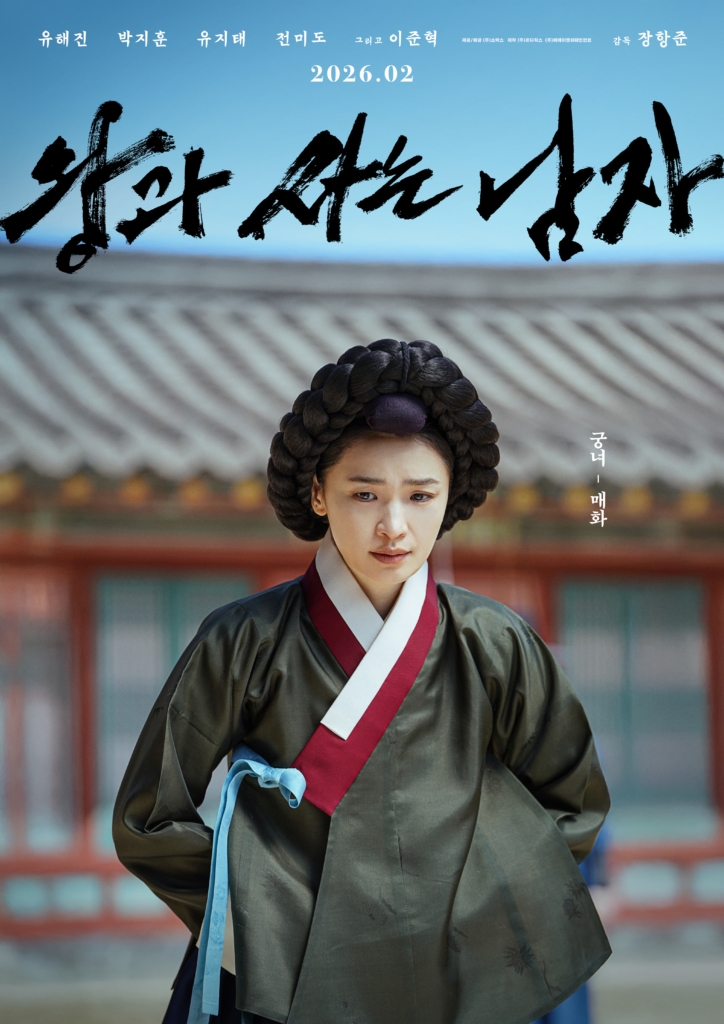
Some movies you watch. Some movies you survive. The King’s Warden — known in Korea as (Wang-gwa Saneun Namja) — very much belongs to the second category. Directed by Jang Hang-jun, the film opened in South Korea on February 4, 2026, and it hasn’t looked back since. It marks Jang’s sixth feature film and the first Korean production to ever put King Danjong — the sixth monarch of the Joseon Dynasty — at the center of a theatrical narrative. The story follows Eom Heung-do, a village head (hojang) in Yeongwol who, at enormous personal risk, chooses to stand by a deposed teenage king living in exile right on his doorstep. The film expanded to the United States on February 13, 2026, launching in Los Angeles, Dallas, and San Francisco before rolling out nationwide through AMC Theatres on February 20 — an unusually wide platform for a Korean-language period drama. Taiwan, Australia, Canada, and New Zealand followed shortly after in the weeks that came.

professional portrait features Korean film director Jang Hang-jun. Known for his signature glasses and warm smile, he takes on a pivotal role in the show ‘The King’s Warden’, bringing his unique cinematic perspective to the audience.
A Box Office Phenomenon — The Numbers Don’t Lie
Let’s put the numbers in plain English, because they are genuinely staggering. As of April 6, 2026 — just 62 days after its release — The King’s Warden has officially shattered expectations by pulling in a cumulative audience of over 16 million admissions in South Korea alone. This monumental feat catapults the film into the Top 3 of the all-time Korean box office chart, now within striking distance of Extreme Job (16.26M). It stands as a singular cultural event, maintaining its dominance for nine consecutive weeks. The film has now generated cumulative revenues exceeding 155.2 billion Korean won (approximately $115 million USD), the highest gross revenue ever recorded in Korean cinema history.
Now here’s where it gets really wild. South Korea has a population of about 52 million people. That means nearly one in every 3.2 Koreans has experienced this film in theaters. If we scale that proportion to the United States — population 333 million — you’re looking at a cinematic event drawing approximately 103 million American viewers. In terms of market impact, the revenue equivalent would soar toward $750 million USD, placing it in the same league as the most legendary global blockbusters.
The film’s international expansion is equally aggressive, proving that this historical narrative carries a universal emotional weight. In North America, what began as a strategic 5-city launch has exploded into a wide release across over 230 theaters as of early April. North American box office revenue has already climbed past $4.2 million USD, comfortably eclipsing the regional records of previous hits like The Roundup: Punishment. From the sold-out premier theaters in Taipei to the emotional screenings in Sydney, social media remains flooded with footage of audiences standing in silence long after the credits roll—a definitive testament to a masterpiece that has transcended cultural boundaries to become a global emotional touchstone.
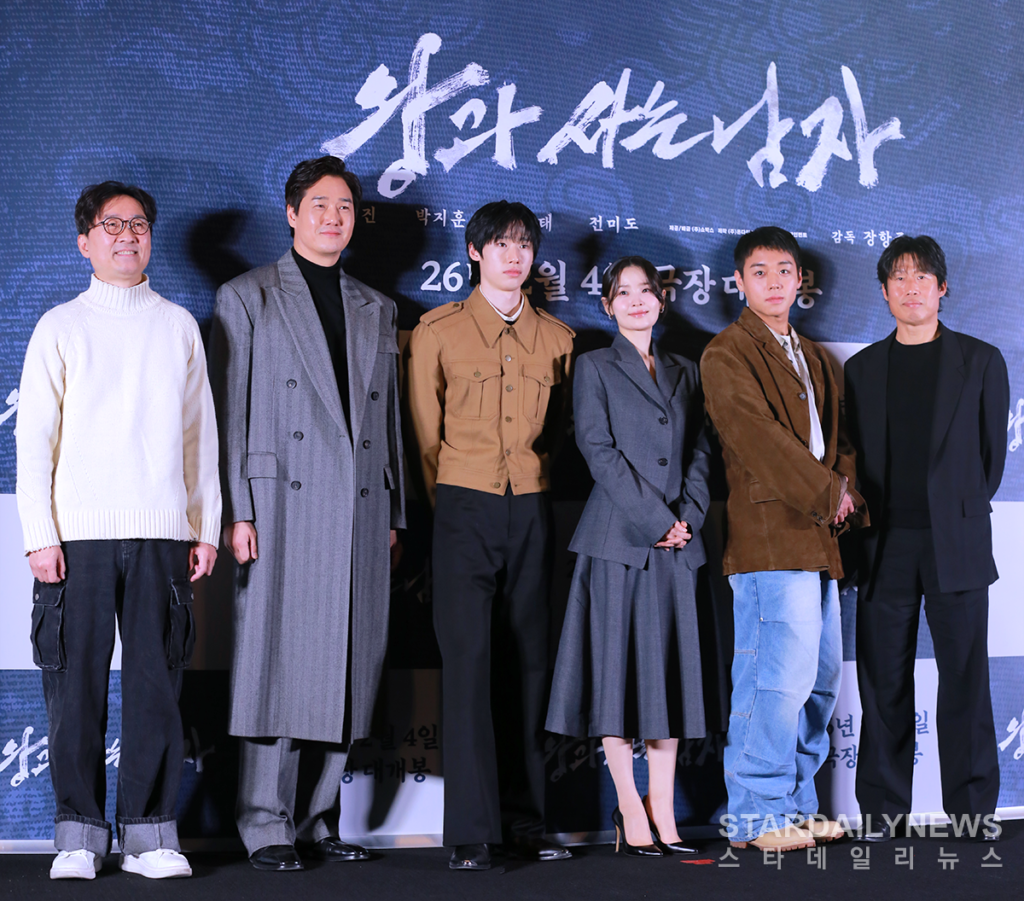
From left: Director Jang Hang-jun, actors Yoo Ji-tae, Kim Min, Jeon Mi-do, Park Ji-hoon and Yoo Hae-jin.
(Photo : www.stardailynews.co.kr)
The History Behind the Film: A Story Too Tragic Not to Tell
To understand why this film cuts so deep, you need to start roughly twenty years before the story begins — with a king so beloved that even his great-grandchildren had to live under the weight of his legacy. King Sejong the Great (reigned 1418–1450) is, without question, the single most revered figure in Korean history. He commissioned the creation of Hangul, the Korean alphabet, so that ordinary people who had never studied Chinese characters could read and write. He oversaw sweeping advancements in astronomy, agriculture, music, and medicine. He built a court of brilliant scholars and reformers. By any standard — East or West — Sejong was an extraordinary ruler. When he passed away in 1450, Korea was at the height of its cultural golden age.
His eldest son, King Munjong, inherited the throne and the enormous expectations that came with it. Munjong had actually been running the government as crown prince for years, handling state affairs while his ailing father rested, so he was hardly inexperienced. But fate had other plans. Just two years into his reign, in May of 1452, Munjong died at the age of 38. The entire weight of the Joseon Dynasty then fell upon the narrow shoulders of his twelve-year-old son.
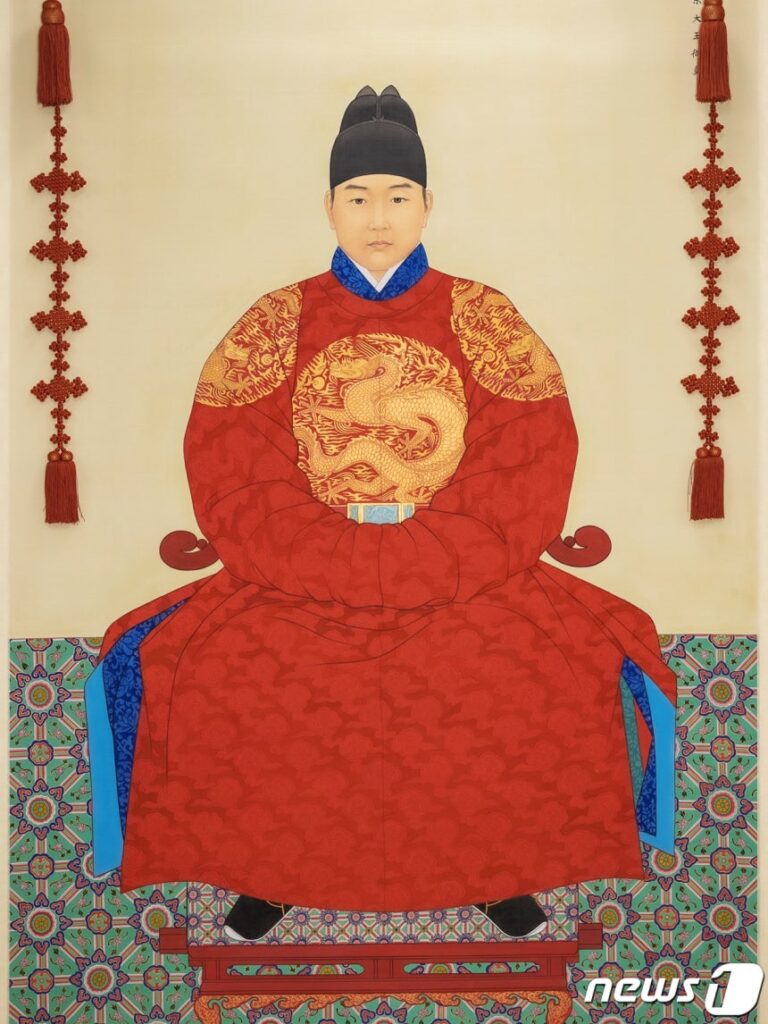
The standard portrait of King Danjong, designated as a significant cultural asset. The King is depicted with a youthful yet dignified facial expression, reflecting his historical record of ascending the throne at a young age. He is dressed in the ‘Gollyongpo,’ the scarlet royal robe of the Joseon Dynasty, featuring an intricate gold-embroidered circular dragon patch. The background includes traditional ceremonial tassels (Norigae) and a decorative floral-patterned floor mat, symbolizing the royal authority of the Korean monarchy.
That boy was King Danjong (1441–1457), and his story is one of the most heartbreaking in Korean history. He had the most unimpeachable royal bloodline of any Joseon monarch — he was the legitimate great-grandson of Sejong and the firstborn son of Munjong, having passed through the crown prince investiture as a child. By every rule of royal succession, no one had a stronger claim to the throne. But legitimacy, as history likes to remind us, means very little without the power to defend it.
The power vacuum left by Munjong’s early death was filled — violently — by Danjong’s own uncle, the ambitious and calculating Prince Suyang. On October 10, 1453, Suyang launched a swift and brutal political coup known as the Gyeyujeongnan. In a single night, the court’s two most powerful ministers — Kim Jong-seo and Hwangbo In — were assassinated, and Suyang’s grip on the government became absolute. The event sent shockwaves through the entire political establishment. Scholars and officials who had sworn loyalty to the young king found themselves either dead, exiled, or forced to bow to a new order.
For two more years, Danjong remained on the throne in name, but everyone at court knew the reality. In the summer of 1455, Suyang’s pressure became impossible to resist, and Danjong formally abdicated — handing the throne to his uncle, who became King Sejo. What followed was a series of desperate, tragic attempts by loyalists to restore the boy to the throne. In 1456, six scholars — now remembered as the Sayuksin, or the “Six Martyred Ministers” — attempted a coup at a royal banquet and paid for it with their lives and the lives of their families. Their failure sealed Danjong’s fate.
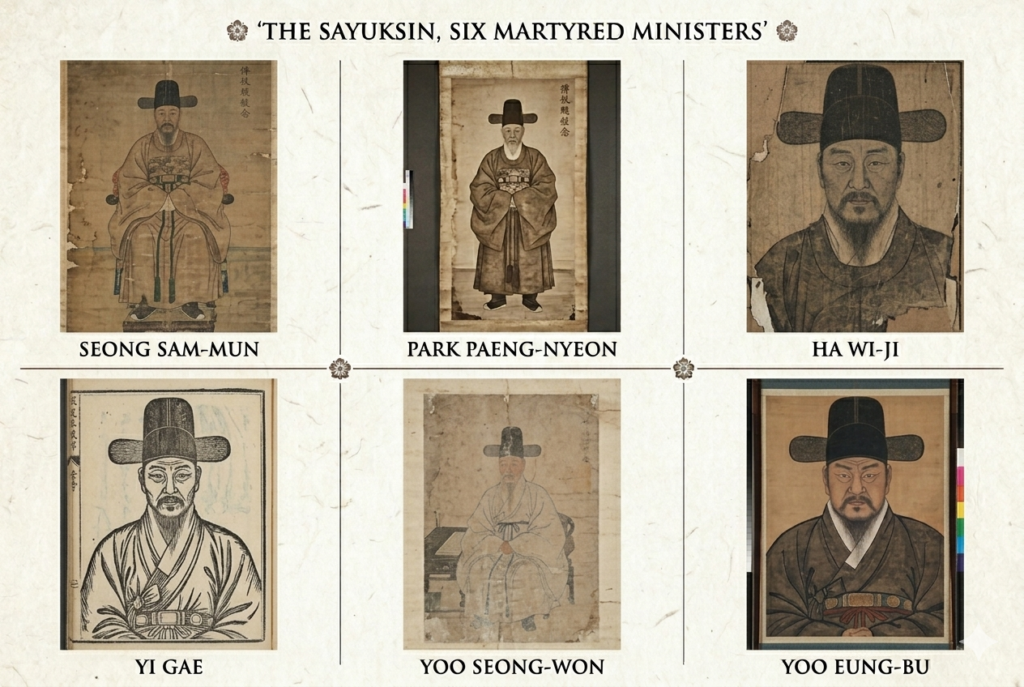
In June 1457, after another accusation of conspiracy involving Danjong’s father-in-law, Sejo finally moved to have his nephew exiled. Danjong was stripped of his royal title — downgraded to the status of mere “Nosan-gun”, a provincial nobleman — and sent to Cheongnyeongpo in Yeongwol, Gangwon Province. It’s a hauntingly beautiful place, and a hauntingly cruel one: a small peninsula wrapped on three sides by the Donggang River and blocked on the fourth by sheer cliff face. There was no way in or out without a boat. The deposed king, still only fifteen years old, was effectively marooned.
That autumn, in October 1457, Danjong died. He was sixteen. The official record in the Annals of Sejo states that he “hanged himself,” which most historians interpret as a courteous euphemism for a state-ordered execution. His name could not be spoken openly for more than two hundred years. It was only in 1698, under King Sukjong, that Danjong was finally restored his royal title and recognized as a legitimate king of Joseon.
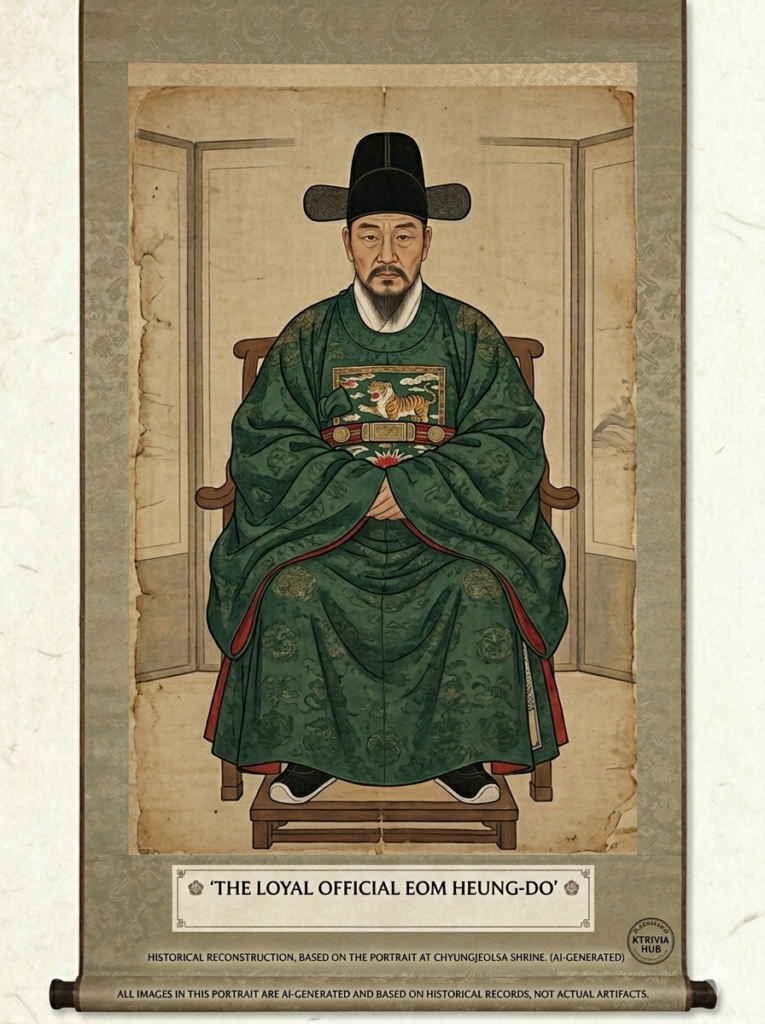
Enter Eom Heung-do, the man at the heart of this film. He was the hojang — a kind of administrative village chief — in Yeongwol at the time of Danjong’s death. When the boy-king died and fear kept everyone else at a safe distance, Eom Heung-do stepped forward. He personally gathered a coffin, led the local officials and townspeople, and buried Danjong with proper funerary rites at a site about five ri (roughly two kilometers) north of the town. It was an act of extraordinary courage in a political climate where even showing sympathy for Danjong could cost you your life and your family’s.
What’s Real, What’s Invented — And Why It Doesn’t Really Matter
One of the things that makes The King’s Warden so fascinating to pick apart is the question of where actual history ends and Jang Hang-jun’s imagination takes over. The short answer is that the factual foundation is solid — and the imaginative architecture built on top of it is what makes the movie soar.
Let’s talk facts first. The Annals of Danjong and the Annals of Sejo — both part of the UNESCO World Heritage-listed Joseon Dynasty Annals — confirm the core narrative: Danjong was exiled to Yeongwol in 1457 and died there the same year. Eom Heung-do’s act of collecting the body and giving the king a proper burial is recorded, briefly, in official records. His loyalty was recognized enough by later generations that in 1733, during the reign of King Yeongjo, the government issued an official document called the Wanmun — a formal administrative certificate exempting Eom Heung-do’s sixth-generation descendants from military and labor conscription as an acknowledgment of their ancestor’s loyalty. This document, measuring 205cm by 37.4cm, was publicly exhibited for the first time in March 2026 at the National Library of Korea, and it is very real. Additionally, two biographical records — the Jeung Champan Eom-gong Silgi (1817) and the Chunguigong Silgi (1936) — document Eom’s life and deeds in detail.
What the historical record does not give us is any account of what the relationship between Eom Heung-do and Danjong actually looked like on a human level. The official histories note the act; they don’t record the conversations, the shared meals, the trust built between a grieving teenager and a middle-aged village administrator. That’s where director Jang steps in. The film’s central premise — that Eom Heung-do essentially volunteered to serve as Danjong’s guardian and companion throughout the exile, that a genuine bond of affection developed between the two men — is entirely the director’s invention, and a beautifully executed one. The character of Maehwa, a woman who moves between the exile compound and the outside world, is also a fictional creation. In an interview, Jang acknowledged the creative liberties but framed them as an attempt to give voice to a relationship that history left in silence: “The records tell us what Eom Heung-do did. I wanted to ask — but what did he feel?”
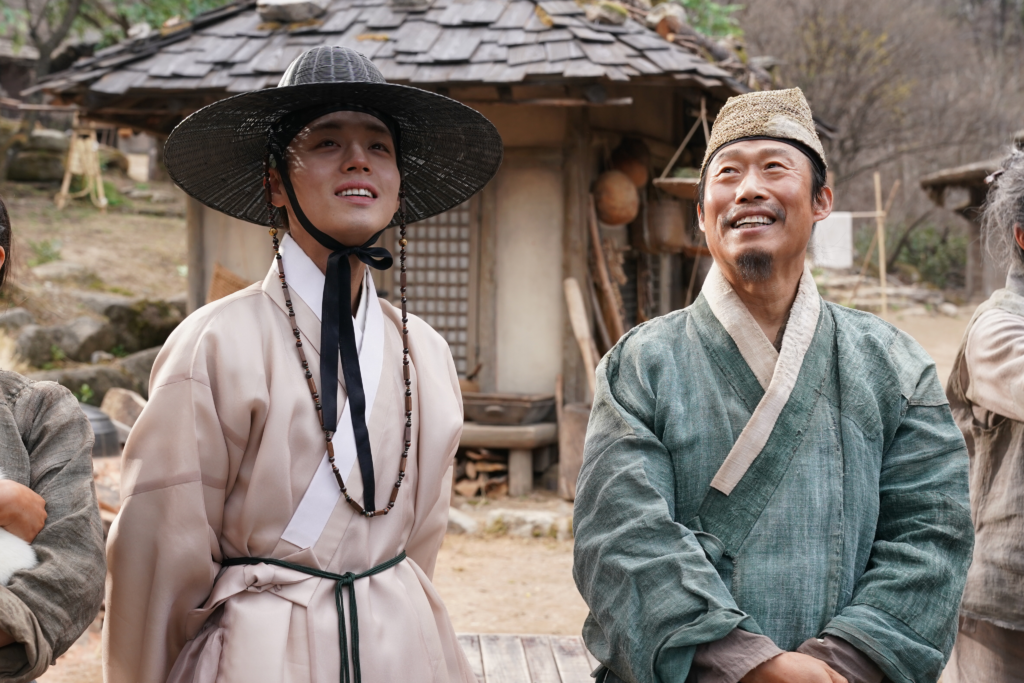
The Four Performances You Won’t Stop Thinking About
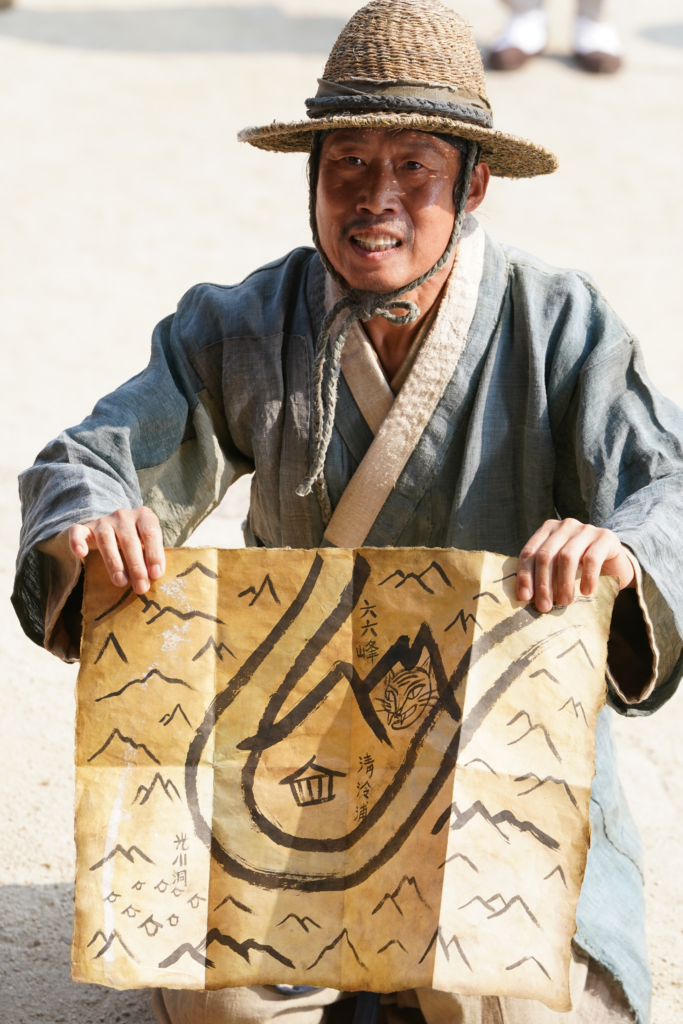
Yoo Hae-jin is not just an actor; he is a cultural institution in South Korea. With a career spanning over three decades, he has redefined the concept of a “scene-stealer,” evolving from a beloved supporting actor into one of the most bankable and respected leading men in the industry. Known for his grounded, earthy charm and an uncanny ability to blend razor-sharp comedic timing with profound emotional depth, Yoo possesses a chameleonic range that few can match. Whether he is playing a gritty detective, a resourceful commoner in a period epic, or a warm-hearted neighbor, he brings an unmistakable authenticity to every frame.
His filmography is a testament to his versatility and Midas touch at the box office. From the legendary gambler in “Tazza: The High Rollers” and the charismatic pirate in “The Pirates” to his transformative, heart-wrenching lead performance in “A Taxi Driver,” Yoo has consistently anchored some of the highest-grossing films in Korean history. His recent turn in the 2026 mega-hit “The King’s Warden” further cements his status as a master of his craft. In this film, he masterfully portrays the grit and resilience of a Joseon-era commoner, proving once again that he is the emotional heartbeat of any narrative. Off-screen, his humble persona and intellectual curiosity—often showcased in popular variety shows—have earned him the nickname “The People’s Actor.” In an industry often obsessed with fleeting trends, Yoo Hae-jin remains a timeless force, a true artist whose presence alone guarantees a masterpiece.
Park Ji-hoon, who first captured international hearts as a standout member of the iconic K-pop group Wanna One, has successfully transitioned into one of the most promising actors of his generation. In his latest cinematic endeavor, “The King’s Warden” Park takes on the historically weighty role of Danjong, the young exiled king of the Joseon Dynasty. While many idol-turned-actors struggle with the gravity of historical dramas, Park delivers a performance that does far more than just hold its own—it commands the screen.
What could have easily been a passive or merely decorative portrayal of a tragic royal becomes, in Park’s hands, something profoundly affecting. He eschews the typical tropes of a “weak king,” instead bringing a bewildered yet bone-deep dignity to a teenage boy acutely aware of his impossible position. His Danjong is a masterclass in subtlety, choosing quiet grace over loud despair, a creative choice that has resonated deeply with critics and fans alike.
The international response has been particularly noteworthy. Following the film’s release, Park’s performance became a trending topic on global platforms. Notably, Chinese-language reviewers on Douban—a platform known for its rigorous and often critical film community—singled out Park for high praise, lauding his emotional depth and mature screen presence. This cross-cultural acclaim proves that his acting transcends language barriers, solidifying his status as a serious actor on the global stage.
Building on the grit he showed in the critically acclaimed series Weak Hero Class 1, Park Ji-hoon in The King’s Warden proves he is no longer just a “visual” star, but a versatile artist capable of carrying the emotional weight of a grand historical narrative. His portrayal of Danjong is expected to be a defining moment in his career, bridging the gap between his K-pop roots and his future as a leading man in Korean cinema.
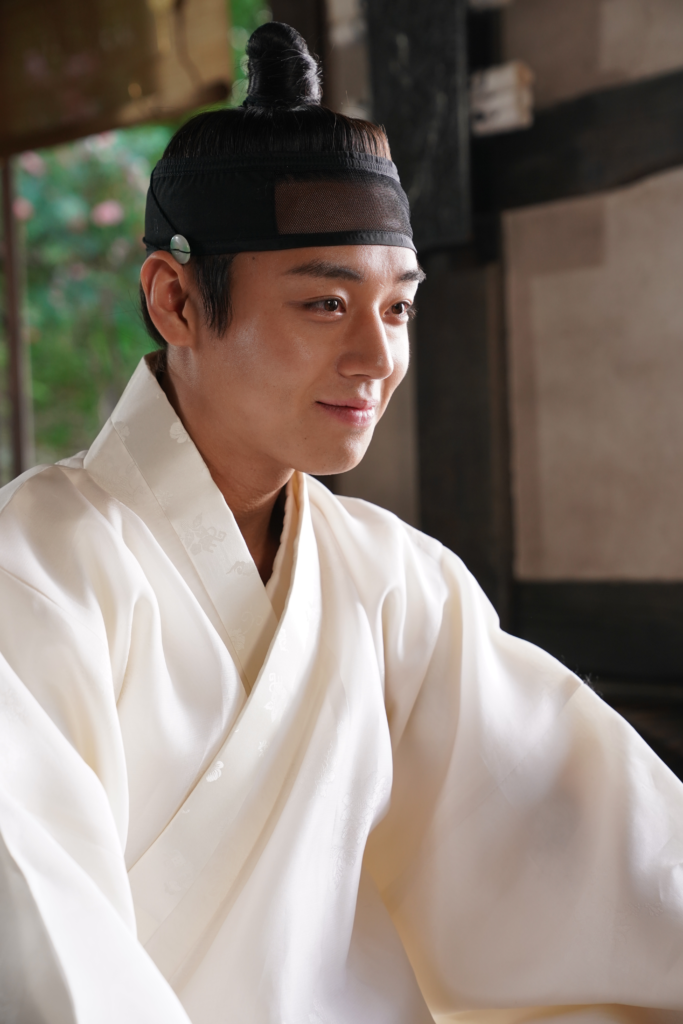
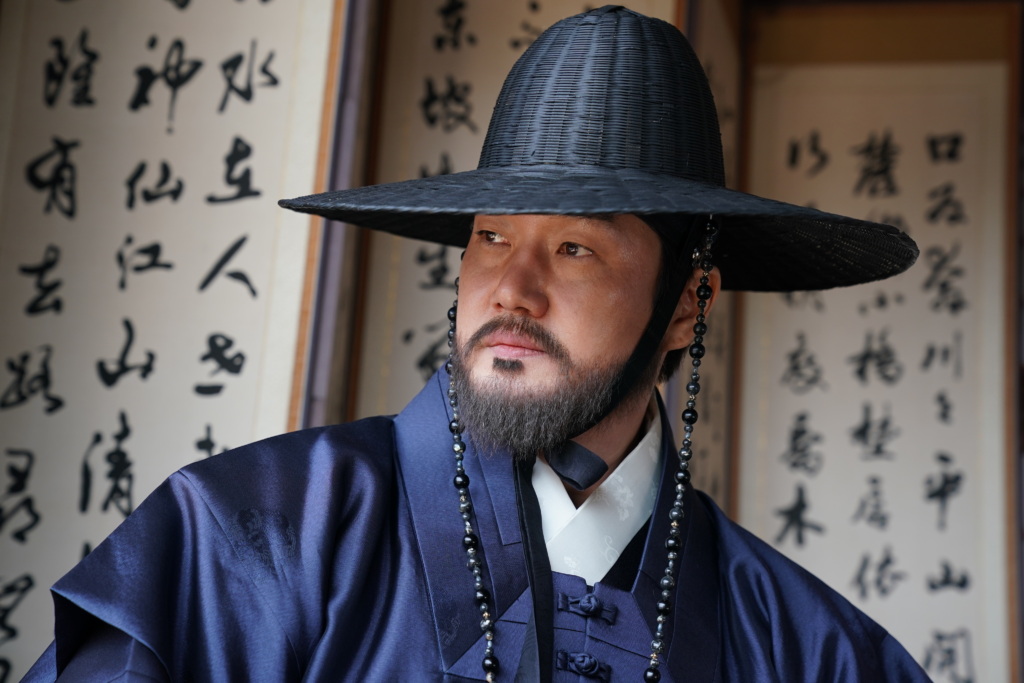
Yoo Ji-tae is one of South Korea’s most versatile and sophisticated actors, renowned for his commanding screen presence and intellectual aura. Since his breakout role in the cult classic “Oldboy,” he has consistently pushed boundaries, transitioning seamlessly between arthouse cinema and mainstream blockbusters.
His tall stature and calm yet piercing gaze allow him to portray a wide spectrum of characters, from calculating villains to warm-hearted idealists. Beyond acting, his passion as a director and humanitarian reflects his profound commitment to the arts and society. In the 2026 sensation “The King’s Warden,” Yoo once again delivers a powerful performance, bringing a majestic gravity to the screen that only a seasoned veteran of his caliber can achieve.
Jeon Mi-do is a highly acclaimed South Korean actress celebrated for her extraordinary range and emotional depth. Originally a powerhouse in the musical theater world, she gained widespread international fame through her breakout television role as the tone-deaf yet brilliant doctor, Chae Song-hwa, in the hit series Hospital Playlist.
In the upcoming film “The King’s Warden”, directed by Jang Hang-jun, Jeon Mi-do continues to showcase her versatile acting skills. Known for her ability to bring a naturalistic and grounded presence to her characters, her involvement in this historical project has generated significant buzz among K-content fans worldwide. Beyond her acting prowess, Jeon is also recognized for her vocal talent, often contributing to the soundtracks of her projects. As she transitions between theater, television, and film, Jeon Mi-do remains one of the most respected figures in the Korean entertainment industry, consistently delivering performances that resonate deeply with audiences.
Why Critics and Audiences Can’t Stop Talking About It
Korean film criticism has not been uniformly uncritical — some reviewers, including Cine21, have noted that the film’s visual effects are occasionally rough around the edges and that certain narrative elements feel underdeveloped. Director Jang himself acknowledged in an interview that some of the CGI was compromised to meet the release date. And yet the audiences keep coming. Cine21‘s own writers capture the paradox perfectly: “Audiences at GV screenings kept saying the same thing — that they hadn’t laughed and cried together in a movie theater in years. Watching a hall full of strangers respond to this film together felt like the scene from Cinema Paradiso. It felt like the theater we remembered had finally come back.”
Overseas, the response has been even more direct. On Rotten Tomatoes, the audience score sits at 96–98%, driven largely by North American viewers who came in with no prior knowledge of Korean history and left completely undone. User “Tina” wrote: “A must-see for anyone who loves a story with a beating heart. One of the best films of the year.” “Saechaan H.” offered: “A historical drama set in the Joseon Dynasty — it was absolutely brilliant. Funny, moving, and enjoyable for every single age group.” Another viewer, “southcastle3523,” wrote: “I had no idea it was based on a true story. The characters felt so alive.” One viewer from Boston noted that the landscape photography had moved him so deeply that he intended to visit Yeongwol and Danjong’s tomb before the year was out.
The Australia and Taiwan markets have also responded with sold-out screenings and word-of-mouth that extended the initial run by weeks. In short, the film’s emotional core — loyalty, grief, the impossible weight of just being a decent human being in indecent times — appears to translate without subtitles.

Yeongwol Right Now: A Town Transformed
The small mountain town of Yeongwol — population about 35,000 — is having a genuine moment. According to data compiled by the Korea Federation of Small and Medium Business, tourism-related business revenues in the area jumped 35.7% in the four weeks following the film’s release, with accommodation and restaurants surging by an extraordinary 52.5%. Weekend revenue spiked by 68.5% compared to the month prior. More than 70,000 visitors made their way to Cheongnyeongpo and Jangneung in that period alone — nearly double the town’s entire permanent population. Trains from Seoul to Yeongwol began selling out on weekends and holiday periods, and local guesthouses are booked through the spring.

📍 Planning a Trip to Yeongwol? Here’s Where to Go
Explore Filming site and neighboring hotspots in Yeongwol.
If the film has put Yeongwol on your radar — and it absolutely should — here’s a quick rundown of the highlights. The obvious first stop is Cheongnyeongpo, the actual exile site where Danjong lived out his final months. You access it by a short ferry crossing on the Donggang River (admission: around 3,000 KRW), and the atmosphere is — genuinely, not just as a marketing line — unlike anything else in Korea. Three sides of clean river water, one wall of sheer pine-covered cliff, and the kind of quiet that makes you understand why it was chosen as a prison without bars.
From there, head to Jangneung, Danjong’s tomb, which is part of the UNESCO World Heritage-listed Royal Tombs of the Joseon Dynasty. The grounds are serene and well-maintained, and the site includes a memorial hall honoring 268 people — royals, officials, and servants — who were associated with Danjong’s fate. Don’t miss Seondol, a dramatic standing-stone rock formation rising from the Seondol Valley that offers one of the most photographed views in Gangwon Province.
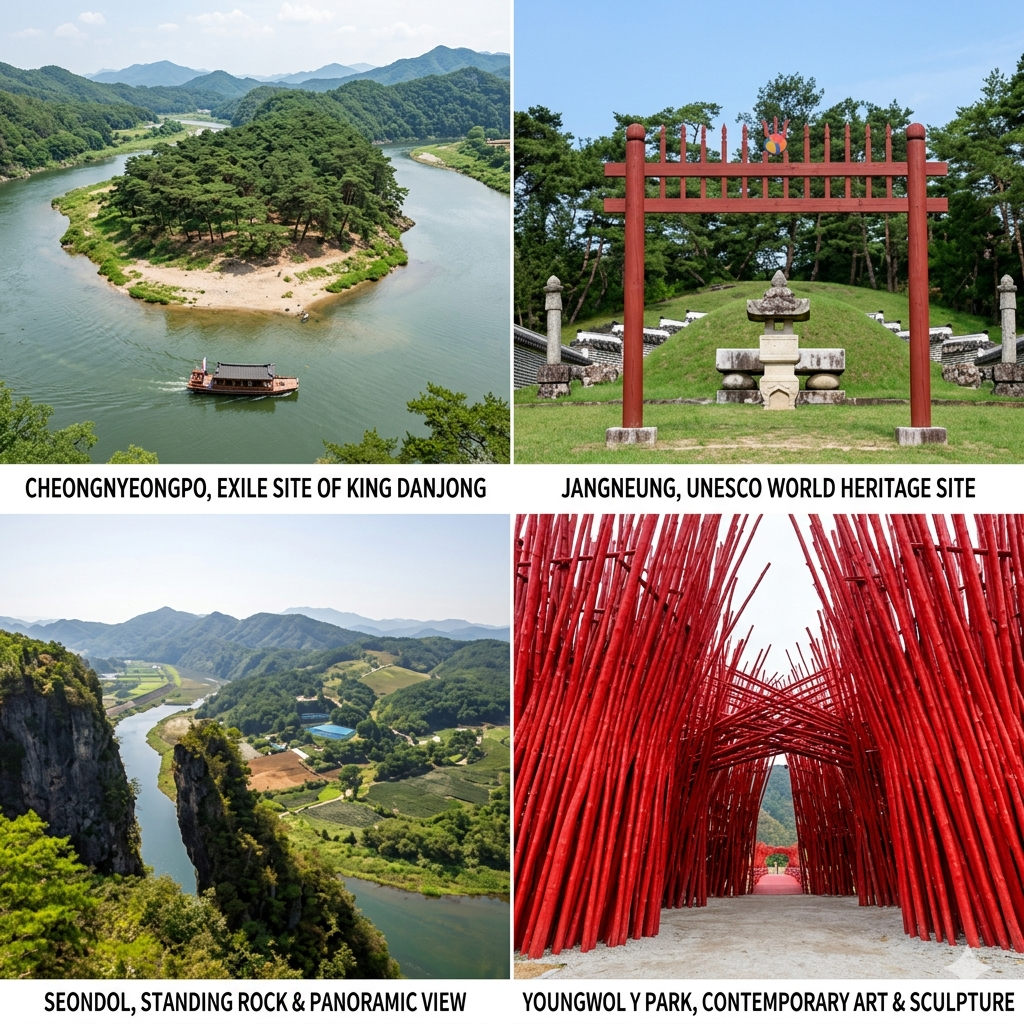
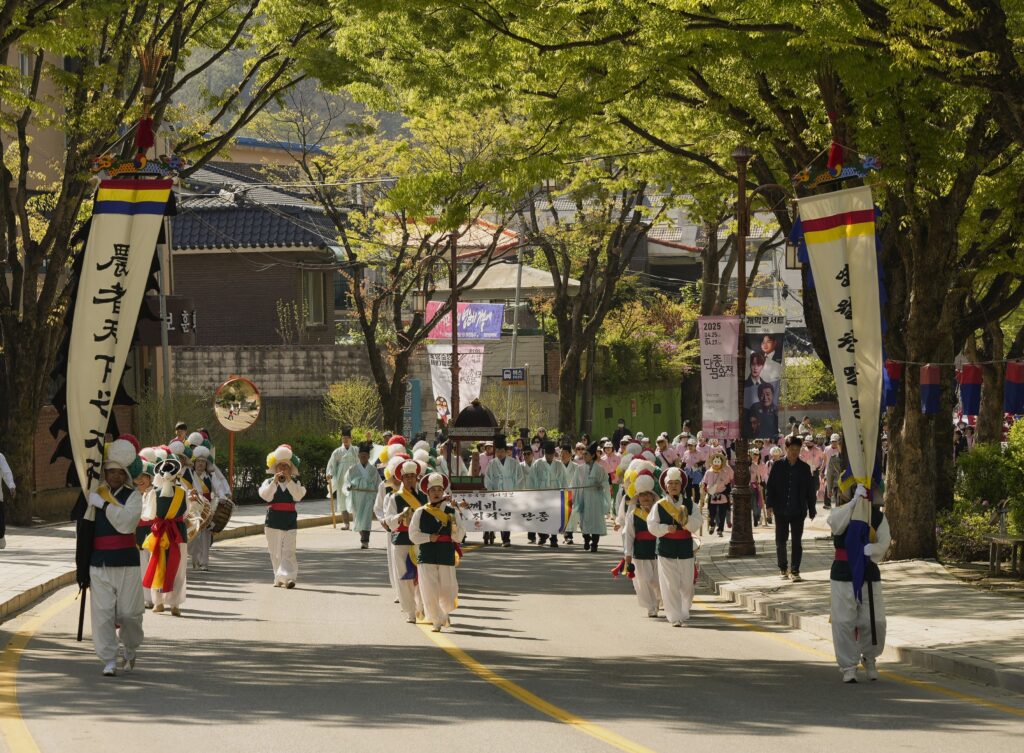
If you have an extra half-day, Jeolmeun Dal Y-Park is a surprisingly excellent contemporary art museum that makes for a nice contrast to all the heavy history. And mark your calendar: the Danjong Cultural Festival, scheduled for April 24–26, 2026, promises three days of performances, historical reenactments, and traditional ceremonies in and around Jangneung and Cheongnyeongpo — a genuinely spectacular event in a year when the whole country is paying fresh attention to Yeongwol’s story.

👑 Did you find the cinematic journey of “The King’s Warden” moving?
Your ‘Like’ is a great encouragement for our journey to uncover the hidden stories and historical depths behind the film.
If you want to keep exploring more exciting K-trivia, please press the button below!